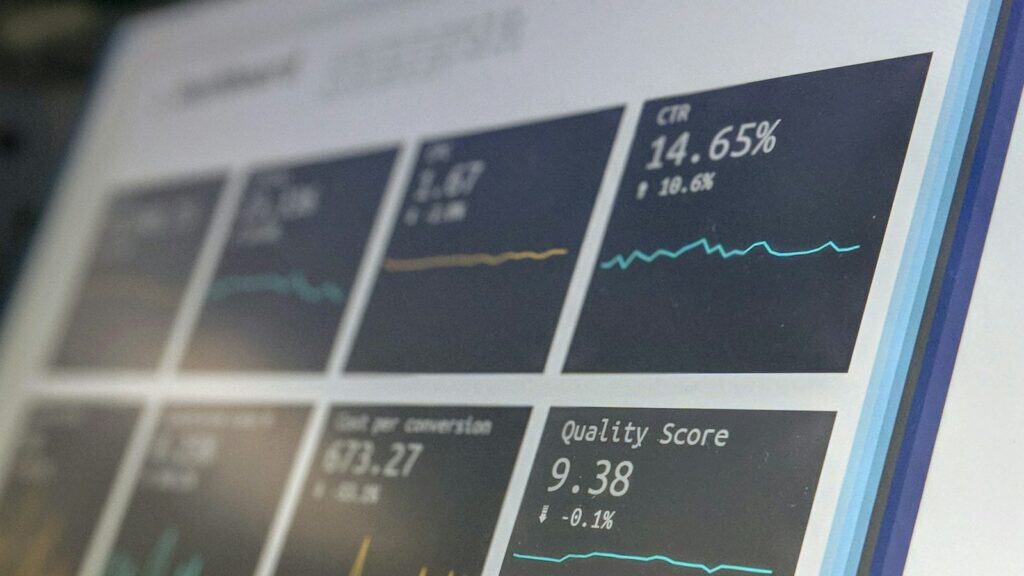

Most businesses pay about $5.42 per click and about $66.69 per lead on Google Ads. Those are the 2026 averages across 23 industries. But the average hides a lot. A restaurant pays around $2.05 a click. A law firm pays around $9.87. What you actually pay depends on your industry, where you advertise, and how well your account is built.
There is no set price for Google Ads. You are not buying a package. You are bidding against other businesses for the same clicks, and the price moves every day.
So the useful question is not “what do Google Ads cost”. It is “what should a click and a lead cost in my industry, and am I paying more than that”. This post gives you the numbers to check.
What does Google Ads actually charge you for?
Google charges you when someone clicks your ad. You do not pay to show up in the results. You pay for the click.
There is one exception worth knowing about. If you run a local service business, Google Local Services Ads charge you per lead instead of per click, which is a very different deal. We compare the two in Local Services Ads vs Google Ads.
You set a daily budget and a bidding strategy. Google runs an auction every time someone searches. Your position and your price depend on your bid, your Quality Score, and what your competitors are doing at that moment.
This matters because two businesses bidding on the same keyword can pay very different prices. The one with better ads and a better landing page usually pays less for the same position. Google explains this in its Quality Score documentation, which scores your account from 1 to 10 based on expected click through rate, ad relevance, and landing page experience.
What is the average cost per click in 2026?
The all industry average cost per click is $5.42. That comes from WordStream’s 2026 Google Ads benchmarks, based on 13,474 US search campaigns running between April 2025 and March 2026.
Here are the other headline numbers from the same study:
| Metric | All industry average, 2026 |
|---|---|
| Click through rate | 6.64% |
| Cost per click | $5.42 |
| Conversion rate | 8.18% |
| Cost per lead | $66.69 |
Use these as a rough sanity check, not a target. If your cost per click is $6 and the average is $5.42, you are fine. If it is $25, something is worth looking at.
What does a click and a lead cost in my industry?
Industry is the single biggest driver of price. Categories where one customer is worth thousands of dollars have expensive clicks, because everyone can afford to bid more.
These are the industry figures we could confirm from the 2026 data:
| Industry | Cost per click | Conversion rate | Cost per lead |
|---|---|---|---|
| Arts and entertainment | $1.63 | Not confirmed | $26.84 |
| Restaurants and food | $2.05 | Not confirmed | $30.57 |
| Automotive repair and service | Not confirmed | 15.51% | $29.96 |
| Animals and pets | Not confirmed | 16.22% | Not confirmed |
| Career and employment | Not confirmed | 3.05% | Not confirmed |
| Furniture | Not confirmed | 2.99% | Not confirmed |
| Finance and insurance | Not confirmed | 2.64% | Not confirmed |
| Attorneys and legal services | $9.87 | Not confirmed | $131.63 |
Where a cell says “not confirmed”, the figure was not published in the source data, so we left it out rather than guess.
Look at the spread. Cost per lead runs from about $26.84 in arts and entertainment to about $131.63 for attorneys. That is roughly five times the price for one lead. If you are in a high cost category, a $60 lead is a good result, not a problem. We break this down further in our guide to cost per lead benchmarks by industry.
How much should you budget to start?
Work backwards from leads, not forwards from budget. Decide how many leads you need each month, then multiply by a realistic cost per lead.

Here is what the 2026 averages work out to at different budgets. This is simple math on the $5.42 average click and the 8.18% average conversion rate, not a promise:
| Monthly ad spend | Clicks at $5.42 | Leads at 8.18% |
|---|---|---|
| $1,000 | about 185 | about 15 |
| $2,000 | about 369 | about 30 |
| $5,000 | about 922 | about 75 |
| $10,000 | about 1,845 | about 151 |
Two warnings about this table. First, your industry numbers will differ, sometimes a lot. Second, a new account almost never hits the average in month one. Google needs conversion data before its bidding works well, so the first 30 to 60 days usually cost more per lead than the months after.
Below about $1,000 a month, Google Ads gets hard. You do not collect enough conversions for automated bidding to learn, and you cannot test much. That does not mean it cannot work. It means you have to be very narrow about which keywords you buy.
Why is my cost per click higher than the average?
Usually it is one of five things, and four of them are fixable.
- Your keywords are too broad. Bidding on “lawyer” instead of “estate planning lawyer in Austin” puts you in a bigger, more expensive auction against people who are not really your competitors.
- Your Quality Score is low. Weak ad relevance or a slow landing page means you pay more than a competitor for the same spot. Our post on boosting your Google Ads Quality Score covers the fixes.
- You have no negative keywords. Without them you pay for searches like “free”, “jobs”, “salary” and “how to do it yourself”.
- Your location targeting is too wide. Advertising to a whole state when you serve one city means paying for clicks you cannot convert.
- Your industry is just expensive. This one you cannot fix. Legal, insurance, and finance clicks cost what they cost.
If you want to sanity check your keyword list, our free Google Ads keyword suggestion tool will show you related terms and give you a sense of what is worth bidding on.
Does agency management count as part of the cost?
Yes, and people forget it. Your total cost is ad spend plus management. If you spend $3,000 on ads and pay $800 to an agency, your real cost per lead is based on $3,800, not $3,000.
Most agencies charge either a flat monthly fee or a percentage of ad spend. We cover the normal ranges and what should be included in our guide to Google Ads management pricing.
The thing worth checking is whether management pays for itself. If an agency lowers your cost per lead by more than their fee, they are free. If it does not move, you are just paying more per lead.
Cost per click is the wrong thing to optimize
Cheap clicks are easy to get. Bid on vague keywords and your cost per click will drop tomorrow. Your sales will drop too.
What actually matters is what you pay for a customer, and what that customer is worth. A $20 click that converts at 15% into a $4,000 job is a great deal. A $2 click that never converts is money set on fire.
This is why we look at return on ad spend rather than click price. If that metric is new to you, start with our explainer on ROAS and then set a floor using break even ROAS.
Common questions
Is there a minimum spend for Google Ads?
Google does not set a minimum. You can run ads on $10 a day. The practical floor is different though. Under roughly $1,000 a month it is hard to gather enough conversion data for automated bidding to work properly, so results get unpredictable.
How much do Google Ads cost per month for a small business?
It depends entirely on your industry and how many leads you need. Using the 2026 averages, $2,000 a month works out to roughly 369 clicks and roughly 30 leads. In an expensive category like legal, the same budget buys far fewer.
Why did my cost per click suddenly go up?
Usually a competitor raised their bids, or you changed something in the account. Seasonality matters too. Many categories get more expensive in their busy season because more advertisers are bidding.
Are Google Ads cheaper than Facebook ads?
No, usually the opposite. Meta clicks and leads normally cost less. The trade off is intent. Someone searching on Google is looking for what you sell right now. Someone on Facebook was not looking for anything. We compare both in Google Ads vs Facebook Ads.
Do I pay when someone sees my ad but does not click?
On Search campaigns, no. You pay per click. Some other campaign types, like Display and video, can charge per thousand impressions instead, so check which bidding model your campaign uses.
Can I lower my Google Ads costs without losing leads?
Often yes. Adding negative keywords, tightening location targeting, and improving landing page speed usually cut wasted spend without touching the searches that actually convert. Those three are the first places we look in any account.
Want a second opinion on what you are paying?
If your cost per lead looks nothing like the numbers above, it is worth finding out why before you raise the budget. Our Google Ads management team can review your account and show you where the money is going and which changes would move your cost per lead first.
No pitch and no commitment. Get in touch and we will walk you through what we find.